
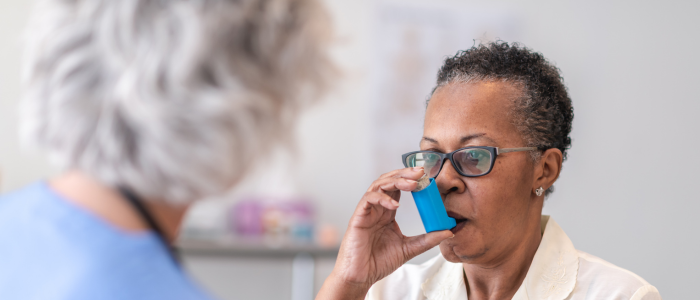
Treatments for COPD help to relieve symptoms, slow progression of the disease and prevent flare-ups. When determining the best treatment for you, your provider will consider your symptoms, your spirometry results, your history of exacerbations and any comorbidities that may be affecting your respiratory health.
What medication will I be prescribed?
There are several types of inhalers used to treat COPDD, including short- and long-acting bronchodilators and anti-inflammatory (steroid) inhalers. Different inhalers or medications are often used together in combination therapy.
The medications that your healthcare provider prescribes to treat your COPD will be based on your lung function, your symptoms, your health status and your risk of exacerbations or flareups. They will also consider how well you can use the inhaler, as inhalers come in different forms.
Using your inhaler improperly can mean you are not getting the full dose of medication. We have more information (including videos) in our How to Use your Inhaler section. Ask your provider, pharmacist, respiratory educator or nurse to assess how you use your inhalers to ensure proper technique.
It’s important that you take the right medication at the right time to best manage your COPD. Your COPD action plan can help you track when and how much medication to take.
Bronchodilators
Bronchodilators relax the muscles around the airways, which helps to open the airways to help you breathe easier. This medicine is delivered using an inhaler device. There are different types of inhalers containing different types and amounts of medication.
Long-acting bronchodilators reduce the swelling in your airways and prevent COPD symptoms from occurring. They need to be taken at or around the same time every day, even when you feel well. Short-acting bronchodilators work quickly to relax your airways and make it easier for you to breathe. You take these medications if you have symptoms. Although they work quickly so that you get relief from symptoms fast, these medications wear off in a few hours.
- Beta2-agonists relax the tightened muscles around your airways, which opens the airway and makes breathing easier.
- Muscarinic antagonists (also called anticholinergics) prevent the muscles around your airways from tightening and help clear mucus from your lungs. This allows you to cough up mucus more easily.
Examples of short-acting beta-2 agonist (SABA) inhalers:
- Ventolin Diskus
- Ventolin Airomir
- Bricanyl Turbuhaler
Examples of short-acting muscarinic antagonist (SAMA) inhalers:
- Atrovent
Examples of long-acting beta-2 agonist (LABA) inhalers:
- Onbrez Breezhaler
- SereVent Diskhaler, SereVent Diskus
- Oxeze Turbuhaler
Examples of long-acting muscarinic antagonist (LAMA) inhalers:
- Turdoza Genuair
- Seebri Breezhaler
- Spiriva Handihaler, Spiriva Respimat
- Incruse Ellipta
Steroid (anti-inflammatory) medications
Inhaled corticosteroid (ICS) medication is prescribed to decrease inflammation, swelling and mucus production inside the airways. ICS is not used alone to treat COPD but may be prescribed as an add-on to a LAMA, LABA or both.
Example of ICS inhalers:
- Pulmicort Turbuhaler
- Flovent HFA, Flovent Diskus
Combination therapy
If your provider prescribes either LAMA or LABA inhalers alone, this is called monotherapy. They may prescribe dual combination therapy, which combines LAMA and LABA or LABA and ICS.
Some inhalers deliver a combination of medications. For example:
SABA + SAMA = Combivent Respimat
LABA + ICS = Symbicort Turbuhaler, Breo Ellipta, Advair, Advair Diskus
LABA + LAMA = Duaklir Genuair, Ultibro Breezhaler, Ispiolto Respimat, Anoro Ellipta
The use of a LAMA, LABA and ICS together is called triple combination therapy. For example:
LABA + LAMA + ICS = Trelegy Ellipta, Breztri Aerosphere
The benefits of staying active
Pulmonary rehabilitation (PR) can help you live and breathe better through exercise, education and support.
PR is an excellent way for you to learn how to manage your disease and stay active while living with COPD. PR is a supervised, multi-week program that helps people who have lung diseases like COPD to live and breathe better through exercise, education and support.
Participants must be referred to a PR program, which is typically offered by a hospital, with sessions being held at the hospital or at local recreation or community health centre.
The demand and need for PR far exceeds the number of spaces in programs across Canada. Although PR is highly recommended as part of a treatment plan for COPD and other lung conditions, it can be difficult to access a local program (if there is one nearby) due to waiting lists, lack of transportation or inability to take time off work.
The Canadian Lung Association offers a free, online program of exercise and education called BreatheSTRONG that can be done by anyone in the comfort of their own home. It is a great way to maintain regular physical activity following pulmonary rehab or can be done as you wait for a spot in an in-person program.
If your blood oxygen levels are chronically low even when you’re not exerting yourself, your provider may prescribe oxygen therapy.
Every cell in your body needs oxygen. When your lungs are damaged, they can’t absorb enough oxygen from the air you breathe. In turn, your blood doesn’t carry enough oxygen through your body. This can result in hypoxemia, or low blood oxygen. Hypoxemia can cause headaches, confusion and shortness of breath. The heart and the brain are particularly sensitive to, and can be damaged by, low oxygen levels.
To determine if you could benefit from supplemental oxygen, your healthcare provider will refer you for an assessment. If your blood oxygen levels are chronically low even when you’re not exercising or otherwise exerting yourself, your provider may prescribe oxygen therapy. You may need to use oxygen constantly or only at certain times, such as overnight.
Oxygen is not used to treat breathlessness, it is used to treat low blood oxygen levels.
Measuring lung function and blood oxygen
The six-minute walk test (6MWT) is used to determine how well your lungs function during exercise. Your blood oxygen will be tested before you start walk to get a baseline number. You will then be asked to back and forth in a room or up and down a hallway for up to six minutes. Your blood oxygen, heart rate and blood pressure are monitored. These numbers, along with how many “laps” you completed, will determine your capacity for aerobic exercise. This test may be used prior to beginning pulmonary rehabilitation or to determine if you would benefit from supplemental oxygen. Testing your blood oxygen levels as you exercise is sometimes referred to as “walking oximetry” testing.
An arterial blood gas (ABG) test can be used to determine how well your lungs are able to move oxygen into the blood.
Using a pulse oximeter to measure blood oxygen levels
A pulse oximeter is a small device used to check your pulse rate and how much oxygen your blood is carrying. It does this by passing beams of light through the blood.
The blood oxygen level measured with an oximeter is called your oxygen saturation level (or SpO2). In most healthy people, this number is between 94% and 100%. It can be lower in people with lung or heart conditions.
You may use a pulse oximeter at home to monitor your blood oxygenation before seeking medical attention. If you use a pulse oximeter, especially if you have dark skin, you should not rely on the pulse oximeter reading as the only measure of your oxygenation level.
Factors such as how the oximeter was used, your physical traits and medical conditions and the environment in which the reading was taken can all affect the accuracy of the results. Some reports indicate that pulse oximeter readings can be less accurate in people with dark skin. Reports have also indicated that pulse oximeter readings may be less accurate as oxygen saturation decreases.
Surgical treatment of COPD is typically only used for severe or end-stage disease that has not responded well to other treatment. Your doctor will determine if the possible benefits of the procedure outweigh the potential risks. They will consider your age, any comorbidities you may have, whether or not you smoke cigarettes, psychosocial factors and your potential for improved quality of life following the procedure.
Lung volume reduction
As the damaged lung tissue expands and becomes stretched out, there is less space for the healthy parts of your lungs to expand as you breathe. If the damaged portion of the lung(s) is limited to certain areas, it is possible to remove those sections of lung to allow for the undamaged portions of the lungs to work better, which will make breathing easier.
Lung valve placement
Emphysema causes the lungs to overinflate with trapped air, which makes it difficult to breathe. One option for people with emphysema that doesn’t respond to other treatments is lung (endobronchialvalve) valve placement. Using a bronchoscope (a long, flexible tube with a camera at the end), the doctor inserts a one-way valve into the most damaged portions of the lungs. The valve opens when you exhale, which allows air and other secretions to escape. The valve closes when you inhale, blocking air from getting trapped in the damaged portion of the lungs.
Lung transplant
A lung transplant can involve a single lung or replacement of both lungs. Double lung transplants are much more common. In 2022, 331 double-lung transplants were performed in Canada, and 18 single-lung transplants. Note that these figures include all recipients, not only recipients with COPD.
This section was made possible by an unrestricted educational grant from Astra Zeneca Canada.