

Canada’s lung health charity since 1900
The Canadian Lung Association is the leading organization in Canada working to promote lung health and prevent and manage lung disease. We do this by funding vital research, pushing for improved treatments and smarter policies and supporting patients and their families in managing their health.
Every day, we roll up our sleeves and grapple with the challenges of everything from asthma to the environment. We are the go-to resource for patients, their families, caregivers, health professionals and the general community.
At a national level, we provide trusted and reliable information that promotes a greater understanding of lung disease. Since 1959, we have funded vital research and research training at universities and hospitals across the country so that new treatments and cures can help save lives. We ensure that the federal government and policy makers have the information and expertise they need to develop public policy that supports the lung health of Canadians.
Non-profit and volunteer-based, we depend on donations from the public to support our mission.
Our history

From our earliest days at the turn of the 20th century, the Canadian Lung Association has always been, first and foremost, a grassroots organization dedicated to protecting the lung health of Canadians. We were founded to help combat tuberculosis, the #1 killer in Canada, at a time when there was no national healthcare system and treatment was available only to those who could afford it. Through global pandemics, the proliferation of tobacco smoking and climate change, we raise awareness of preventable threats to lung health, advocate for better treatments and fund lung health research.
Milestones of the Canadian Lung Association and lung health in Canada
Interested attendees of the annual meeting of the Canadian Medical Association in Ottawa discuss the need for a national association to combat the spread of tuberculosis. The Canadian Association for the Prevention of Consumption and Other Forms of Tuberculosis is formed at the Rideau Hall.
South of the border, the National Association for the Study and Prevention of Tuberculosis is established. This organization would later be renamed to the American Lung Association.
Provincial associations join the national association in an effort to combat tuberculosis together.
The first Christmas Seals were sold in Canada, in Toronto and Hamilton.
Parliament passes the Tobacco Restraint Act, banning the sale to and possession of tobacco for minors.
The Canadian Association for the Prevention of Consumption and Other Forms of Tuberculosis simplifies its name to the Canadian Association for the Prevention of Tuberculosis.
The name changes to the Canadian Association for the Prevention of TB.
The field of thoracic surgery was developed.
The first cases of “Spanish flu” in Canada are seen in the spring. Over the next few years, the Great Influenza Epidemic would kill 50,000 Canadians and more than 15 million worldwide.
The Canadian Association for the Prevention of Tuberculosis is again renamed, to the Canadian Tuberculosis Association.
The name changes to the Canadian Tuberculosis Association.
In France, Albert Calmette and Camille Guérin develop the Bacille Calmette-Guerin (BCG) vaccine to immunize against Mycobacterium tuberculosis. Today, this vaccine is one of the most widely used in the world.
Clinical trials of the vaccine would begin in Quebec the following year and in 1933 in Saskatchewan.
Christmas Seals go national, with the Association’s first Christmas Seals campaign. Almost $75,000 is raised.
Well-known American painters or illustrators were chosen to illustrate the American Christmas Seals, of which derivatives were used in Canada until the 1960s.
The first national Christmas Seals campaign is launched in Canada.
Tuberculosis specialist Dr. George J. Wherrell from Manitoba becomes executive secretary of the Association, a post he would hold until 1962.
An article by F. Mueller, titled “Tabakmissbrauch und Lungencarcinom” is published in Zeitung fuer Krebsforschung (the German journal of cancer research). The paper, whose title translates to “Tobacco consumption and lung carcinoma”, was one of the first records of this connection in the scientific literature.
Pulmonary damage by smoking is identified.
Moosejaw, SK becomes the first city in North America to offer chest x-rays.
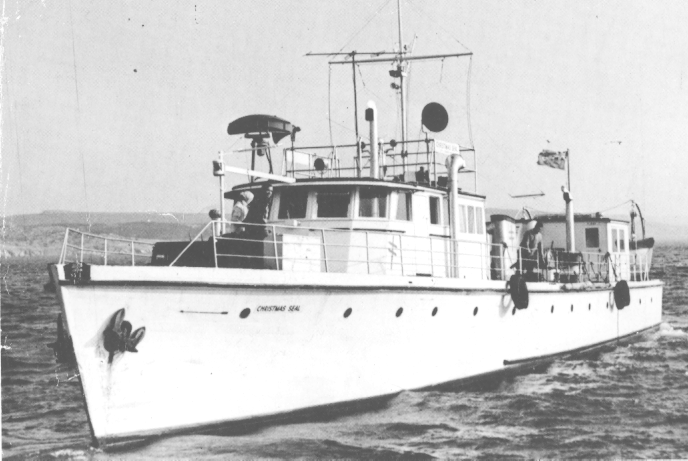
The Newfoundland Tuberculosis Association purchases a former US naval ship for $5,000 USD and converts it into a floating clinic to screen for TB in remote coastal communities. TB was the leading cause of death in Newfoundland until 1947, and at one point it had the highest TB rate in the Western world.
This vessel, the MV Christmas Seal, operated until 1970.
The Canadian Tuberculosis Association officially endorses BCG vaccine as a tool to fight TB.
The Association celebrates its 50th anniversary at its annual meeting in Vancouver. Dinnertime entertainment includes renowned Canadian magician Francis B. Martineau, best known for his silk magic.
Canada hits the peak of tuberculosis sanitoria beds, with 17,364 beds in operation.
When the requirement for TB beds decreased, it was difficult to use these facilities for other purposes due to their remote locations.
A group of members attending the annual meeting of the Canadian Tuberculosis Association in June introduce a motion to more formalize the Association’s medical committee and propose to name the group the Canadian Thoracic Society.
The medical section of the Association is renamed The Canadian Thoracic Society.
Our research funding program begins, with 1% of the gross Christmas Seals revenue being set aside to fund research projects.
Applicants apply for a portion of the $40,000 available. Nine of the 57 tuberculosis-related projects and three of the six non-tuberculosis-related projects are funded.
The Research Grants and Fellowship program is established to fund research in any lung disease area.
The 16th Annual International Tuberculosis Conference is held in Toronto. The planning and execution of this event requires significant CTA resources for two years.
At the conference, members adopt the Mutual Assistance Program to help establish and maintain local and national anti-tuberculosis organizations. One percent of all money raised through the Christmas Seal program by each provincial lung association is earmarked for the program, with CTA opting to support Asian countries in particular. Between 1963 and 1983, CTA donates nearly $1M through the Mutual Assistance Program.
Martin Regenstreif of Montreal became the first Canadian artist to draw the Seals in Canada. He was also the chosen artist for the 1969 and 1970 campaigns.
Regenstrief had also drawn many posters promoting the sale of Victory Bonds during WWII.
The Royal Commission on Health Services, chaired by Justice Emmett Hall, tables its report on the feasibility of a national medicare program. CTA’s executive secretary Dr. George J. Wherrett submitted a report titled Tuberculosis in Canada to the Commission and also made a submission during public hearings held across the country.
National medicare would officially launch on July 1, 1968.
Canada reaches “peak smoking”, with 4,100 cigarettes smoked annually per capita.
In acknowledgment of its widening scope, the CTA changes its name to the Canadian TB and Respiratory Disease Association.
The Canadian Tuberculosis Association changes its name to the Canadian Tuberculosis and Respiratory Disease Association.
First successful trials of cyclosporine – anti-rejection drug used in lung transplants.
The first Canadian conference on air pollution and lung health is organized in Gravenhurst, Ontario by Dr. David Bates. Bates would spend his career researching the affects of ozone and air pollutants on lung health.
The Association adopts the name The Canadian Lung Association.
The Christmas Seals Visiting Professor program is launched to all. Dr. Jacques Chrétien from Paris and Dr. JA Peter Paré from McGill are the first chosen recipients.
Three research studies were published that demonstrated the dangers of second-hand smoke. The studies each showed that women married to smokers had higher rates of lung cancer than women married to non-smokers.
A team at the Toronto General Hospital performs the world’s first successful lung transplant.
In October, NDP MP Lynne McDonald introduces a private members bill, Bill C-204, to regulate smoking in the workplace and on common carriers under federal jurisdiction. The Bill, which became the Non-Smokers’ Health Act, was passed in 1988.
- A research team at SickKids Hospital in Toronto, led by Dr. Lap-Chee Tsui, discovers the gene mutation associated with cystic fibrosis.
- Smoking is banned on all commercial flights within Canada.
The lung associations of Saskatchewan and Manitoba create RESPTREC (Respiratory Training and Educator Course) for healthcare providers. The asthma course was the first RESPTREC offering.
Canada becomes the first country in the world to require picture warnings on cigarette packages.
Development of the first draft sequence of the SARS virus.
The Federal Tobacco Act forbids tobacco company sponsorship of art and sporting events.
Ottawa researcher discovers drug combo that reduces hospital admissions for infants with bronchiolitis.
Advances in lung cancer treatment and personalized care.
Lung associations across the country adopted the new BREATHE logo and refresh the brand of the Lung Association to focus on breathing.
The federal government publishes The Future of Tobacco Control in Canada, committing to fewer than 5% of Canadians smoking by 2035.
The federal government makes tobacco control a priority announcing bold goal of 5% tobacco use by 2035.
Canadian legislation tries to catch up to the emerging vaping trend with amendments to the Tobacco Act and the Non-Smokers Health Act. It becomes legal for e-cigarettes with nicotine to be sold to Canadian adults but the sale or promotion of vaping products to minors is banned.
The federal government announces proposed changes to vaping regulations to deal with impending vaping epidemic among Canadian youth.
The World Health Organization declares COVID-19 a global pandemic on March 11. Vaccinations against COVID-19 begin to be offered in December. More than 50,000 Canadians would die of COVID-19.
The Canadian Lung Association joins forces with other like-minded organizations to provide support, education and information resources about COVID-19.
The Canadian Net-Zero Emissions Accountability Act becomes law, formalizing Canada’s commitment to achieve net-zero emissions by 2050.
Canada became the first country in the world to require cigarette manufacturers to print health warnings on each cigarette.
CLA embarks on new journey as independent national healthy charity, launching its first strategic plan as a standalone organization.
BREATHE THE LUNG ASSOCIATION (Reg. no. TMA1051780); RESPIREZ L’ASSOCIATION PULMONAIRE (Reg. no. TMA1051781); RESPIREZ CANADA (Reg. no. TMA1051775); THE LUNG ASSOCIATION (Reg. no. TMA420444); LUNGS ARE FOR LIFE (Reg. no. TMA314583); DOUBLE-BARRED CROSS DESIGN (CROSS OF LORRAINE) design (Reg. nos. TMA100856, TMA100856) are registered trademarks of the Canadian Lung Association.