
On this page
What are the symptoms of asthma?
Most people with asthma will first show symptoms when they are young. Asthma symptoms are different from person to person and they can change overtime.
Because asthma symptoms only happen sometimes, many people believe they only have asthma sometimes. Asthma is constant, it is only the symptoms that are intermittent. Even if you have “very mild” or “mild” asthma, it is important that you take your medication as directed as you at still at risk of having an asthma attack or even death.
People with asthma often have one or more of these symptoms:
- Persistent or recurring coughing, often (but not always) at night or early in the morning,
- Difficulty breathing/wheezing
- Shortness of breath, feeling like you can’t get enough air into your lungs and that may make it difficult to talk or eat
- Chest tightness
- Large amount of thick fluid or phlegm in your airways
- Difficulty breathing while exercising
- Losing sleep because of breathing troubles
What happens during an asthma attack
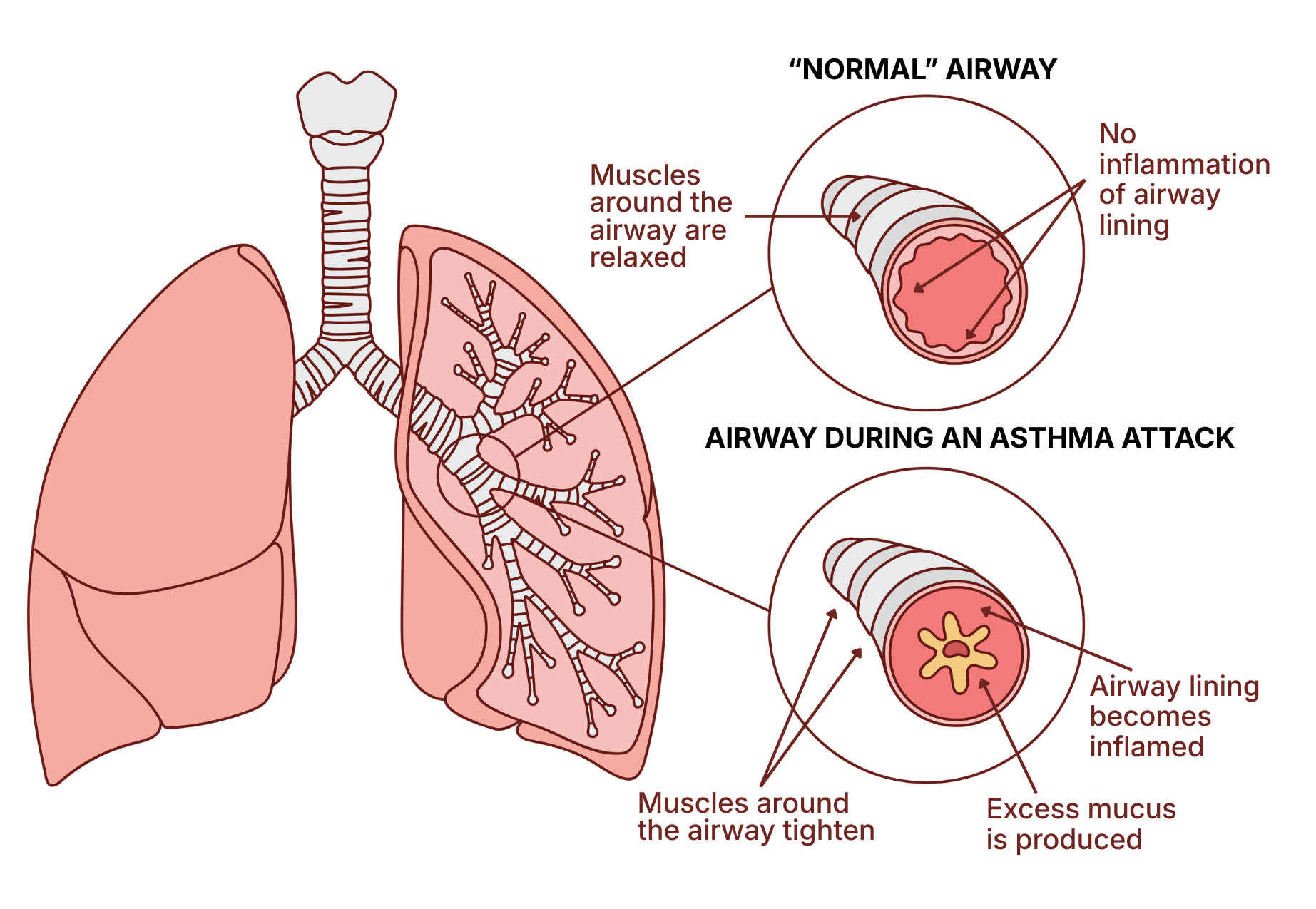
Asthma can be a medical emergency. If you have any of these symptoms you must go to the emergency department right away or call 911. Use your rescue medication (blue puffer) as directed in the Red Zone of your asthma action plan.
- struggling for breath
- blue rescue inhaler doesn’t help
- difficulty speaking, can’t finish a sentence
- sucking in skin above breastbone and between ribs
- nostrils flaring out
- pale, grey, sweating
- blue lips or nail beds
- really tired, lethargic
- loss of unconsciousness (fainting)
Know what to do in case of an asthma attack. Print our C.A.R.E. poster, created in partnership with Asthma Canada.
What causes asthma?
There is no single cause of asthma. Things like family history, indoor and outdoor air pollution and exposure to certain workplace chemicals can make a person more likely to get asthma.
Family history
If people in your family have asthma, hay fever (allergic rhinitis) or eczema, there is a higher chance you will have asthma. Family history can also include social determinants of health. For example, children and youth with asthma living in lower income neighbourhoods, as well as those living in households with lower education levels, are admitted to hospital more frequently. Those in the lowest income quintile are more likely to smoke, more likely to live near a high-traffic roadway and less likely to have a primary care provider, which can all contribute to higher asthma incidence and higher hospitalization rates.
Air pollution
Living in areas with a high level of air pollution, such as traffic-related air pollution found near busy roadways, can increase your chance of developing asthma.
Indoor air pollution can also contribute to development of asthma. Children whose mothers smoked while pregnant and/or who grew up in a house where someone smoked are more likely to get asthma. Children who grow up in homes with mould or dust are also more likely to get asthma.
Workplace chemicals
Being exposed to certain chemicals in the air at work can, over time, cause your body to become sensitized or react to these chemicals. When exposed to these chemicals, your immune system is triggered, and you can experience asthma symptoms. You can develop asthma years after being exposed to certain chemicals.
If you’re exposed to a high level of some irritants even once, this can cause a type of asthma called reactive airways dysfunction syndrome (RADS). Chlorine or anhydrous ammonia are examples of chemicals that can cause RADS. The symptoms develop soon after the exposure. They may reappear again even after years, when exposed to this irritant again.
Chemicals in the workplace can also make pre-existing asthma worse.
Diagnosing asthma
Your healthcare provider will look for a history of symptoms that are typical of asthma. Your provider will consider if your symptoms:
- only happen sometimes, and they are sometimes worse than others,
- are worse at night and/or when you wake up,
- can be triggered by allergies, cold air, exercise or even laughing,
- are worse right after you exercise, and/or
- get worse when you have a cold or other respiratory infection.
They will do a physical exam and ask you about your health and family history. They may ask about your history tobacco smoking and previous exposure to certain chemicals in your environment.
If your provider suspects you may have asthma based on this information, they may test your lung function using a test called spirometry.
If spirometry is not available, they may measure how much and how quickly you can forcefully breathe air out of the lungs, called your peak expiratory flow (PEF). PEF is measured with a device called a peak flow meter.
Spirometry is the preferred method of diagnosing asthma in adults and children 6 years old and older. Using a device called a spirometer, your healthcare provider will measure how much air you can breathe out of your lungs and how fast you can do it, before and once after using a bronchodilator (puffer).
Airflow limitation caused by diseases like chronic obstructive pulmonary disease (COPD) and bronchiectasis can sometimes be reversed with a bronchodilator, so it should not be the only factor used to diagnose asthma.
Some doctors will offer spirometry testing in their office, while others will refer you to a lab or clinic that specializes in lung testing.
If your spirometry results before and after using a bronchodilator (inhaler) don’t show a significant difference but your provider still suspects you may have asthma, they may be asked to take an inhalation challenge test. Airway sensitivity is a sign of asthma. Challenge tests measure how reactive your airways and lungs are to certain triggers.
Methacholine challenge test
In a methacholine challenge test, you will be asked to inhale doses of methacholine, a drug that can cause narrowing of the airways. Spirometry will be repeated after each dose of methacholine to measure how much your airways narrow or constrict.
Exercise challenge test
Most people with asthma have some decreased airflow during or after exercise. In an exercise challenge test, spirometry is done before and after you exercise (usually on a treadmill or an stationary bike) to see what effect exercise has on airflow.
Cold air challenge test
Cold air is a common asthma trigger. Spirometry is done before and after inhaling cold air. If exercising in cold air is a suspected trigger, an exercise challenge test using cold air may be done.
You may also have a specific inhalation challenge. In this test, your doctor exposes you to a small amount of the material that may be causing your symptoms and then measures your lung function.
Do I have asthma or COPD?
It’s important to know if your symptoms are being caused by asthma or COPD so you can receive the right treatment and know how to manage your symptoms. Some people who have asthma are misdiagnosed with COPD and some people are diagnosed with asthma when they actually have COPD. And some people have both asthma and COPD, which is referred to as asthma-COPD overlap syndrome, or ACOS (LINK).
Both asthma and COPD are obstructive lung diseases, meaning breathing is difficult because of an obstruction or narrowing of the airways. Both COPD and asthma can cause coughing, shortness of breath and wheezing.
Asthma
- tends to develop earlier in life, often in childhood
- involves inflammation of the airways
- often a family history of asthma
- more likely to also have allergies or rhinitis (“hay fever”)
- symptoms will vary widely from day to day
- triggered by exercise, allergens and/or cold air
- coughing is typically “dry” (not phlegmy)
- inflammation of the airways can be reversed quickly using an inhaler
- doesn’t cause low blood oxygen levels except in cases of severe asthma attack
- goals of treatment are to reduce inflammation and control
COPD
- tends to develop in adults 40 years and older
- involves inflammation and damage to the structure and function of the lungs
- often a history of smoking or exposure to smoke
- symptoms are fairly consistent day to day but gradually get worse over time
- coughing is more likely to be “productive” (phlegmy)
- most flareups caused by respiratory infections or air pollution
- airflow obstruction is not fully reversible
- having other diseases or conditions caused by lack of oxygen to cells and organs are common
- goals of treatment are to reduce symptoms, prevent exacerbations and decrease mortality
Diagnosing asthma versus diagnosing COPD
The results of a lung function test (spirometry) will indicate if your airways are obstructed. Once this is confirmed, your provider will determine if asthma or COPD is the cause. Your provider will consider your medical history including if you have a history of smoking. A history of smoking is more common in COPD.
You may be asked to use an inhaler that reduces inflammation in your airways (a bronchodilator) before repeating the spirometer test. The more “normal” your results after using the inhaler, the more likely it is that you have asthma as the damage caused by COPD is less reversible.
You may also be given medication to try over several weeks before you repeat testing using the spirometer.
Do I have mild, moderate or severe asthma?
The severity of your asthma is defined by the amount of medication required to maintain good control of your asthma.
| Very mild asthma | Well controlled with a reliever needed only occasionally |
| Mild asthma | Well controlled with a single low-dose controller. Reliever needed twice a week or less. |
| Moderate asthma | Well controlled with low- to moderate-dose dual controller with occasional reliever needed, twice a week or less. |
| Severe asthma | Controlled with high-dose dual controller and additional medications with a reliever needed twice a week or less OR unable to achieve control. |
Almost all asthma can be well controlled. When asthma is well controlled, you can do more and feel better and live a healthy, active life, almost symptom free. Working with your healthcare provider to understand the severity of your asthma will help you best manage it.
Is my asthma well controlled?
Asthma is a chronic (long-term) disease that requires regular medication. It’s vital that you take your medications as prescribed — including taking your controller medication even if you feel well. This will help to keep your asthma under control and avoid your symptoms worsening or having an asthma flare-up.
Note that individuals can have well-controlled asthma but still be at risk for exacerbation.
Ask yourself…
If you answer YES to any ONE of these questions, your asthma may not be well controlled. You may wish to make an appointment to talk to your healthcare provider, a pharmacist or a certified respiratory educator (CRE).
- Do you experience daytime symptoms such as a cough, wheezing, shortness of breath and/or chest tightness more than 2 days a week?
- Do you experience symptoms during the nighttime once a week or more?
- Does asthma limit your physical activities?
- Do you ever have asthma flare-ups?
- Do you miss work or school because of your asthma?
- Do you need your reliever medication/inhaler more than 2 times a week?