
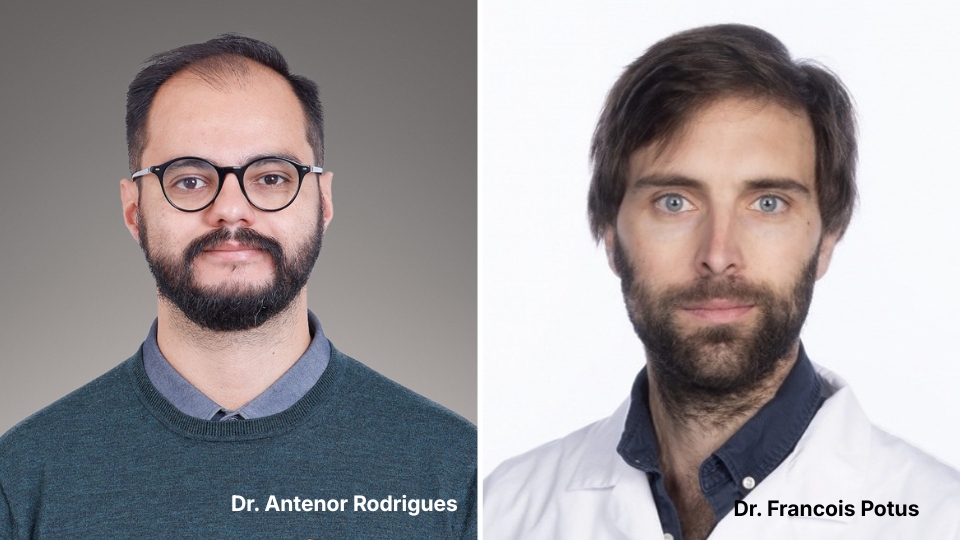
The Canadian Lung Association (CLA) and the Pulmonary Hypertension Association of Canada (PHA Canada) congratulate Dr. Antenor Rodrigues and Dr. François Potus, the recipients of the 2026 Wilma Shastry PAH Research Awards.
“As an early-career researcher, this award comes at an important stage of my career,” says Dr. Rodrigues. “It will provide the preliminary data needed to develop future large-scale funding applications and establish a research program focused on improving the lives of people living with pulmonary arterial hypertension, both in Canada and internationally.”
Dr. Rodrigues, an associate professor in the School of Rehabilitation at Université Laval in Sherbrooke, Quebec, will study activin inhibition and skeletal muscle adaptation in PAH. The goal of the study is to improve understanding of why patients continue to experience exercise limitations despite advances in treatment and to improve exercise capacity, physical function, and quality of life for people living with PAH.
“It is one year of funding, and it is meant to be a beginning,” says Dr. Potus, an associate professor of medicine at Université Laval. “This is the early, uncertain stage that is hardest to fund but nothing else moves forward without. It also funds people. Much of this work will be done by graduate students in my laboratory in Québec City, for whom this project is their training and their first published papers. And the lung and heart tissue that makes it possible was donated by patients at the hardest moment of their lives.”
Dr. Potus’s team will test whether sotatercept, a recently approved drug for PAH, relaxes lung blood vessels and whether it acts on the heart muscle directly. This would help explain why some patients improved faster than expected but the drug did not improve how well their heart pumps.
About the Wilma Shastry Awards
The objective of the Wilma Shastry awards is to build Canadian research capacity to address pulmonary arterial hypertension (PAH) in Canada. The awards are one-year, $40,000 grants that support innovative research related to the diagnosis, treatment, and/or mechanisms of pulmonary arterial hypertension (PAH). The awards are funded primarily by generous donor contributions in support of respiratory and PAH research.